

Book a pre-season PPM service and confirm your TM44 status before late May. That single action does more to protect your cooling systems, your compliance position, and your occupants’ comfort than any reactive fix during a heatwave. Under the Workplace (Health, Safety and Welfare) Regulations, employers must maintain reasonable thermal comfort, and systems with an effective rated output above 12 kW require a TM44 inspection at least every five years. Delta First can arrange both.
Three actions to take now:
- Walk your plant rooms and air handling units: check for visible filter blockages, condensate overflow, and unusual noise.
- Confirm whether your air conditioning systems exceed 12 kW and when your last TM44 certificate was issued.
- Contact Delta First to book a pre-season survey or secure a priority engineer slot before the summer demand peak.
Table of Contents
- What does a pre-summer HVAC maintenance checklist look like?
- What are your UK compliance obligations for summer HVAC?
- When should you schedule maintenance, and what does it cost?
- How do you prepare for peak heat and heatwaves?
- How do you choose the right maintenance partner?
- Key takeaways
- Why proactive summer maintenance matters more than most FM teams realise
- Get your site summer-ready with Delta First
- Useful sources and further reading
What does a pre-summer HVAC maintenance checklist look like?
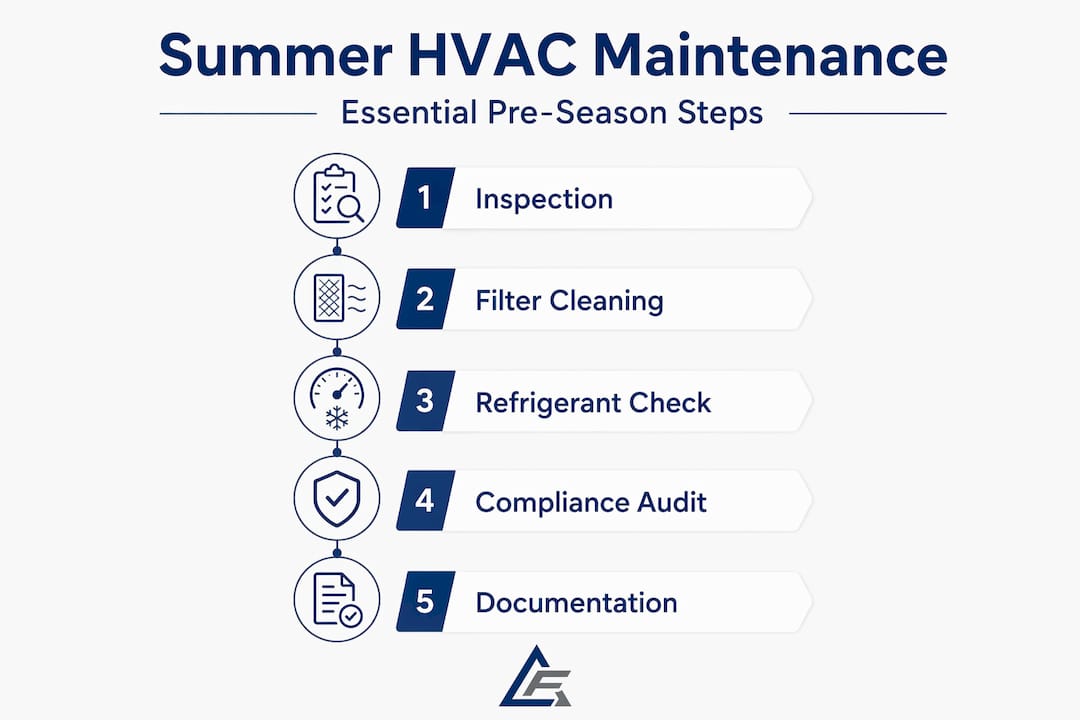
A structured, task-owner-mapped checklist keeps your team and your contractors aligned. Work through these steps in order, ideally between March and May.
- Filters — FM or in-house engineer. Inspect all filters and clean or replace as needed. Check filters monthly during summer; replace disposable units every one to three months.
- Evaporator and condenser coils — specialist contractor. Fouled coils silently reduce cooling capacity and raise energy consumption. Professional cleaning is required; this is not a task for untrained staff.
- Outdoor condenser units — in-house engineer or contractor. Clear debris, vegetation, and obstructions from around all outdoor units. Check fins for damage.
- Vents and registers — FM. Inspect supply and return air grilles for blockages, dust build-up, and correct positioning. Confirm airflow is unobstructed in all occupied zones.
- Condensate drains — in-house engineer. Clear and flush all condensate drain lines and trays. Blocked drains are among the most common silent failures in commercial buildings during summer.
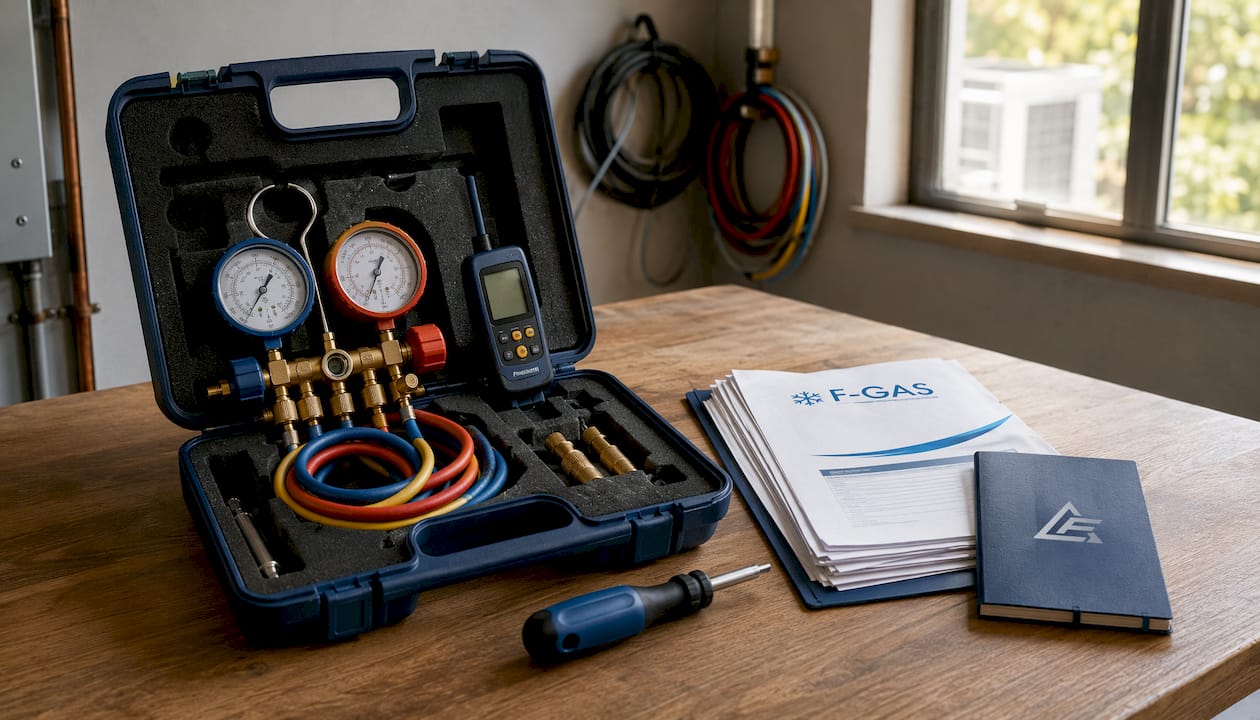
- Refrigerant and leak checks — F-Gas certified engineer only. Refrigerant work is legally restricted to F-Gas certified engineers. Low refrigerant is a hidden fault that compounds under sustained heat load.
- Fan motors and belts — specialist contractor. Inspect all fan motors for wear, check belt tension and condition, and lubricate bearings where specified.
- Controls and thermostats — in-house engineer or contractor. Verify thermostat calibration, test safety interlocks, and confirm BMS setpoints are correct for summer operation.
- Electrical inspection — qualified electrician. Check panel connections, overload protection, and wiring condition in plant rooms. Overloaded circuits are a known failure point during heatwaves.
- Full system run test — FM with contractor sign-off. Run the system for 30–60 minutes and check all zones for even cooling, unusual noise, and odours. Record the result in your building logbook.
Pro Tip: Keep a small spares kit on site: a box of correctly sized replacement filters and a calibrated test thermometer. Both cost very little and can prevent a call-out during peak demand.
Log every visit, task, and finding in your building logbook or digital asset register. Undocumented maintenance is, for compliance and insurance purposes, maintenance that did not happen.
What are your UK compliance obligations for summer HVAC?
Compliance is not optional, and the consequences of gaps extend beyond fines to voided warranties and failed insurance claims.
TM44 air conditioning inspections apply to any system with an effective rated output exceeding 12 kW, which covers the majority of commercial split systems, VRF installations, and air handling units. Inspections must be carried out by an accredited energy assessor at least every five years. The resulting certificate must be retained with your building’s maintenance records and produced on request during an audit. Failure to present a valid certificate can lead to enforcement action.
Employer duty under the Workplace (Health, Safety and Welfare) Regulations: employers must maintain a reasonable working environment, including thermal comfort. The HSE provides practical guidance rather than a fixed maximum temperature, but the duty to act is clear. Documented HVAC maintenance is your primary evidence of due diligence.
F-Gas requirements mean that any work involving refrigerants must be carried out by a certified engineer. This applies to leak checks, top-ups, and system decommissioning. Using an uncertified operative invalidates the work legally and can void manufacturer warranties.
Poor maintenance has direct warranty consequences. Many manufacturers require proof of regular servicing to honour warranty claims. A single missed annual service can be sufficient grounds for a manufacturer to decline a compressor replacement claim.
Pro Tip: Store your TM44 certificates, F-Gas logs, and dated service reports in a single location, whether a physical site file or a digital asset register. Auditors and insurers will ask for all three.
When should you schedule maintenance, and what does it cost?
The practical pre-season window is March to May. Book outside that window and you risk parts shortages, reduced engineer availability, and the real possibility that a fault surfaces during the first heatwave of the year rather than in a controlled service visit.
Key cost drivers for commercial summer HVAC maintenance:
- System size and number of units across the site
- Access complexity (roof-mounted plant, confined plant rooms, multi-storey buildings)
- Whether refrigerant work is required (F-Gas certified labour carries a premium)
- Remedial repairs identified during the service visit
- Spare parts: filters, belts, bearings, and drain components
- Emergency priority response arrangements within your contract SLA
SMEs that invest in regular HVAC maintenance and energy efficiency measures can reduce energy bills by up to 25%, according to government guidance. PPM also extends equipment lifespan, often by several years compared with neglected systems, which materially changes the capital replacement cycle for any FM budget.
| Task | Recommended frequency |
|---|---|
| Filter inspection and replacement | Monthly during summer; every 1–3 months otherwise |
| Condenser and coil clean | Annually (pre-season) |
| Condensate drain check | Every service visit |
| Full system run test | Annually (pre-season); 30–60 minutes duration |
| TM44 inspection | Every five years (systems >12 kW) |
| F-Gas leak check | Per manufacturer schedule and F-Gas regulations |
For a single-site commercial building with a standard split or VRF system, a pre-season PPM visit typically takes half a day to a full day on site. Multi-site or complex AHU installations will require longer. Always confirm scope and duration with your contractor before booking.
How do you prepare for peak heat and heatwaves?
Pre-season servicing reduces the probability of failure, but contingency planning covers the gap when ambient temperatures push systems beyond their design envelope.
- Identify which areas are highest risk: server rooms, operating theatres, care home bedrooms, and data-critical spaces should have priority cooling plans.
- Agree emergency fan deployment and temporary shading options with your FM team before June.
- Confirm condensate overflow contingency: a blocked drain during a sustained heatwave can cause water damage as well as system shutdown.
- Hold a small spares kit on site: spare filters, a belt set for critical AHUs, and condensate drain tablets.
- Specify response times in your contractor SLA. A four-hour emergency response commitment is a reasonable benchmark for critical commercial sites.
Pro Tip: During sustained high ambient temperatures, plant room ventilation becomes a limiting factor. If your plant room overheats, electrical components and controls fail before the refrigeration circuit does. Check plant room louvre condition and consider temporary ventilation fans as a low-cost contingency.
Review your reactive maintenance arrangements before summer. Knowing your escalation path before a fault occurs is far more effective than searching for a contractor mid-heatwave.
How do you choose the right maintenance partner?
Procurement decisions made under pressure produce poor contracts. Evaluate providers before the season, not during it.
Questions to ask every prospective contractor:
- Are your engineers F-Gas certified, and can you provide certification on request?
- Do you hold TM44 accreditation, and will you take responsibility for scheduling inspections?
- What are your insurance levels, and do they cover the full scope of mechanical and electrical work on site?
- What is your guaranteed emergency response time for contract holders?
- Do you hold regional spare parts stock, and what is your typical lead time for common components?
- Do you cover our sites in Essex, Suffolk, Norfolk, or Greater London?
Contract essentials to include:
- Defined scope of works with a task frequency schedule
- SLA response times for both planned visits and emergency call-outs
- Explicit responsibility for TM44 scheduling and certificate retention
- Call-out rates and escalation procedures for out-of-hours faults
- Documentation requirements: dated service logs, F-Gas records, and remedial action reports
For evaluation, consider three tiers: a one-off remedial visit addresses an immediate fault but provides no ongoing protection; an annual PPM agreement covers pre-season servicing and a defined number of visits; a multi-trade planned maintenance agreement covers HVAC alongside electrical, building fabric, and compliance work under a single contract. The last option typically delivers the best cost stability and the clearest accountability. Delta First’s mechanical compliance guide covers what to expect from each tier in more detail.
Key takeaways
Effective summer HVAC maintenance requires pre-season PPM, confirmed TM44 compliance, F-Gas certified engineers, and documented service records, all arranged before late May.
| Point | Details |
|---|---|
| Book before late May | The March–May window gives time to source parts and fix faults before peak demand. |
| Confirm TM44 status | Systems above 12 kW need a five-yearly inspection by an accredited assessor; keep the certificate on file. |
| Use F-Gas certified engineers | Refrigerant work is legally restricted; uncertified work voids warranties and breaches regulations. |
| Document everything | Dated service logs, TM44 reports, and F-Gas records form your compliance and insurance evidence trail. |
| Delta First covers your region | Delta First provides pre-season PPM, TM44 coordination, and emergency response across Essex, Suffolk, Norfolk, and Greater London. |
Why proactive summer maintenance matters more than most FM teams realise
The conventional wisdom is that summer HVAC maintenance is about preventing breakdowns. That framing undersells the real risk. The more damaging scenario is not a sudden failure but a system that keeps running while quietly degrading: fouled coils silently reduce cooling capacity and raise energy consumption, a low refrigerant charge pushes the compressor towards its thermal limit, and a condensate drain can back up unnoticed. None of these trigger an alarm. All of them make a catastrophic failure during the first serious heatwave far more likely.
The compliance dimension compounds this. A facilities manager who cannot produce a valid TM44 certificate or a dated service log is not just facing a potential fine. They are facing an insurer who may decline a claim and a manufacturer who may void a warranty, at precisely the moment when the cost of failure is highest.
Delta First’s approach is to treat the pre-season visit as a compliance audit and a mechanical health check simultaneously. Our engineers across Essex, Suffolk, Norfolk, and Greater London work to a documented PPM schedule (with refrigerant handling carried out by F-Gas certified specialist subcontractors) that produces the service records your auditors and insurers will ask for. Contract holders receive priority scheduling, which matters when every commercial contractor in the region is fully booked in June.
Documented PPM is not just good practice. It is the evidence that your building was managed responsibly, and that distinction carries real weight when a warranty claim or an insurance assessment is on the table.
Get your site summer-ready with Delta First
Delta First gives facilities managers and property owners across Essex, Suffolk, Norfolk, and Greater London a single accountable partner for HVAC summer readiness. Rather than coordinating separate contractors for mechanical, electrical, and compliance work, you get one team, one contract, and one point of contact.

Our pre-season services include PPM visits with full task documentation, TM44 inspection coordination with accredited assessors, refrigerant work by F-Gas certified specialist subcontractors, emergency call-out cover with agreed response times, and multi-trade site readiness checks for commercial offices, healthcare, education, retail, hospitality, and public sector buildings. Every visit produces a dated service log that goes straight into your compliance file.
If you manage hotels or hospitality venues, industrial sites, schools, or local authority properties, Delta First has sector-specific experience across all of them. Priority booking is available for contract holders, and we can accommodate urgent pre-season surveys for new clients.
Request a quotation or a planned maintenance survey at deltafirst.co.uk. Slots fill quickly from April onwards, so the earlier you contact us, the more options we can offer.
Useful sources and further reading
- TM44 air conditioning inspection guidance — GOV.UK: the primary reference for inspection obligations, certificate requirements, and accredited assessor criteria.
- HSE workplace temperature guidance — HSE.gov.uk: HSE’s practical guidance on employer duties for thermal comfort, including summer heat management.
- Commercial HVAC maintenance and compliance — Engineering Institute: a clear overview of PPM scope, record-keeping requirements, and F-Gas obligations for UK commercial buildings.
- Delta First building services glossary: definitions for TM44, F-Gas, PPM, and other terms used in maintenance contracts and compliance documents.
- Predictive maintenance guide — Delta First: covers PPM best practices, KPIs, and the case for moving from reactive to planned maintenance.
Retain your TM44 certificates, F-Gas records, and dated service reports together in your building’s maintenance file. They are the documents most likely to be requested during an audit, an insurance claim, or a change of FM provider.
[…] Summer HVAC maintenance: a guide for facilities managers […]
[…] Summer HVAC maintenance: a guide for facilities managers […]
[…] ready before the assessor arrives, and to schedule the visit alongside other compliance or maintenance work already planned for the site. Bundling a TM44 visit with a routine HVAC service call, for instance, […]
[…] Summer HVAC maintenance: a guide for facilities managers […]
[…] Summer HVAC maintenance: a guide for facilities managers […]
[…] Summer HVAC maintenance: a guide for facilities managers […]